Äquatorial-Guinea |
|
 |
|
 |
 |
|
|
|
|
| Übersicht – Contents: | |
Diese Seite ist Teil des Projektes
Äquatorial-Guinea |
|
|
|
|
|
|
|
|
|
| Übersicht – Contents: | |
Flaggen – Flags: |
|
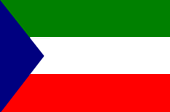 |
National-, Staats- und Marineflagge |
 |
Staats- und Marineflagge |
 |
|
historische Flagge – historical Flag: |
|
|
|
1968–1973, |
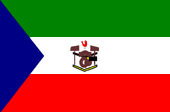 |
1973–1979, National-, Staats- und Marineflagge – national, state and naval flag, Seitenverhältnis – ratio = 2:3, Quelle/Source nach/by: Flags of the World   |
|
|
Bedeutung/Ursprung der Flagge – Meaning/Origin of the Flag: |
|
|
|
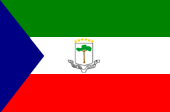
| Die Flagge Äquatorial-Guineas zeigt drei waagerechte Streifen in Grün, Weiß und Rot mit einem flachen blauen Dreieck am Liek und zusätzlich das Wappen des Landes in der Mitte des weißen Streifens. In dieser Form wird sie als Nationalflagge, Staatsflagge und Marineflagge verwendet. Die Flagge wurde am 12.10.1968 anlässlich der Unabhängigkeit von Spanien eingeführt. Das es bis 1973 keine Regelung dazu gab, wurde die Flagge meist ohne Wappen verwendet. Grün symbolisiert die natürlichen Ressourcen des Landes, die Landwirtschaft und den Dschungel. Das Blau symbolisiert das Meer, das das Festland mit den Inseln verbindet. Weiß symbolisiert Frieden. Das Rot symbolisiert das Blutvergießen der Unabhängigkeitskämpfer. Der Baum, der auf der Nationalflagge und im Wappen erscheint, ist der Baumwollseidenbaum. |
The flag of Equatorial
Guinea consists of three horizontal stripes in green, white and red, with a
flat blue triangle at the hoist, and the country’s coat of arms in the
centre of the white stripe. In this form, it is used as the national flag,
the state flag and the naval ensign. The flag was adopted on 12th of October in 1968 to mark independence from Spain. As there were no regulations governing its use until 1973, the flag was usually flown without the coat of arms. Green symbolises the country’s natural resources, agriculture and the jungle. Blue symbolises the sea, which connects the mainland with the islands. White symbolises peace. Red symbolises the bloodshed of the independence fighters. The tree that appears on the national flag and in the coat of arms is the cotton-silk tree. |
| Quelle/Source: Die Welt der Flaggen, Flaggen Wappen Hymnen, Wikipedia (ES) | |
|
|
Wappen – Coat of Arms: |
|
 |
Wappen von
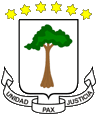
Äquatorial-Guinea – coat of arms of Equatorial Guinea, Quelle/Source: Corel Draw 4, Wikipedia (D) |
|
|
Bedeutung/Ursprung des Wappens – Meaning/Origin of the Coat of Arms: |
|
|
|
| Im Staatswappen ist auf einem silbernen Schild ein Baumwollseidenbaum abgebildet, darüber sechs goldene sechszackige Sterne. Nach anderen Quellen, soll der Baum angeblich ein Maulbeerbaum sein, unter dem in der Mitte des neunzehnten Jahrhunderts die Spanier und König Bonkoro von Bata einen ersten Vertrag abschlossen. Die goldenen Sterne über dem Wappen symbolisieren das Festlandsgebiet und die fünf Inseln des Staates. Unter dem Schild lautet die Aufschrift: "Einheit, Frieden, Gerechtigkeit". Zwischen 1973 und 1979, in der Zeit der Herrschaft von Macia Nguema, galt vorübergehend ein anderes Wappen. | In the arms is to see a
mangrove-tree on a silver shield, over there are six golden six-jaged stars jag. By other
sources should the tree allegedly be a cotton-silk tree, under which in the middle og the
nineteenth century the Spanish and king Bonkoro of Bata came to their first agreement. The
six stars above the shield symbolize the mainland and the five islands of the country.
Beneath the shield the inscription: "Unity, Peace, Justice". Between 1973 and 1979, in the time of the rule of Macia Nguema, was valid an other coat of arms. |
| Quelle/Source: Die Welt der Flaggen, Flaggen Wappen Hymnen | |
|
|
Flugzeugkokarde – aircraft roundel: |
|
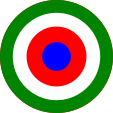 |
Flugzeugkokarde – aircraft roundel Quelle/Source: nach/by Wikipedia (EN) |
|
|
Landkarte – Map: |
Die
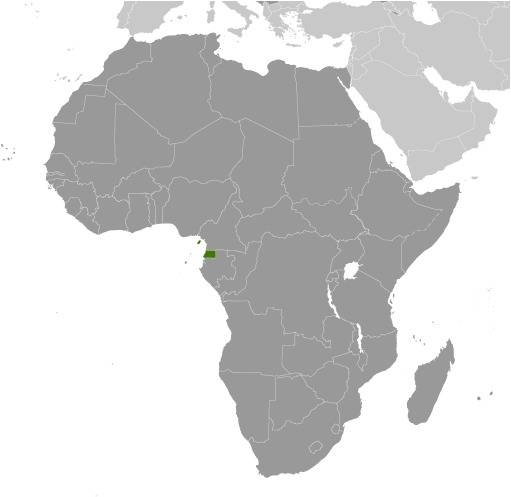
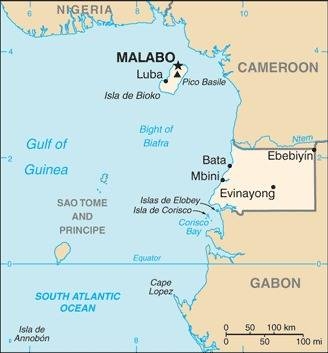
Lage Äquatorial-Guineas – position of Equatorial Guinea: |
Äquatorial-Guinea – Equatorial Guinea: |
|
Zahlen und Fakten – Numbers and Facts: |
|
|
|
|
|
|
|
|
|
|
|
|
|
|
|
|
|
|
|
|
|
|
|
| Quelle/Source:
Wikipedia (D) |
|
|
|
Geschichte: |
|
|
um 1500 · Besitznahme des heutigen Gebiets durch Portugal unter dem Namen Fernando Póo 1778 · Abtretung der Kolonie von Portugal an Spanien 1843 · Eroberung des Festlands durch Spanien ab 1926 · Beginn der systematischen Kolonisierung des Festlands (Río Muni) durch Spanien 1963 · Einführung innerer Autonomie durch Spanien unter dem Namen Äquatorialguinea 29.07.1968 · Unabhängigkeit von Spanien; Wahl von Francisco Macías Nguema zum Präsidenten 1969 · Ausschaltung politischer Rivalen durch Macías; Beginn eines Terrorregimes 1973 · Neue Verfassung; Zusammenführung der Provinzen zu einem Einheitsstaat 1975 · Massenhinrichtungen durch das Regime Macías; massive Fluchtbewegungen 1979 · Sturz und Hinrichtung von Macías durch Teodoro Obiang; Machtübernahme durch Militär 1987 · Gründung der Staatspartei PDGE durch Obiang; Beginn der Einparteienherrschaft 1991 · Neue Verfassung; formale Mehrparteiensysteme, reale Kontrolle durch Präsident und PDGE 1996–2016 · Wiederholte Wahlen mit extremen Ergebnissen zugunsten von Obiang; Vorwürfe der Manipulation 2014 · Vollmitgliedschaft in der Gemeinschaft der Portugiesischsprachigen Länder (CPLP) 2016 · Ernennung von Teodorín Obiang zum Vizepräsidenten; Vorbereitung dynastischer Nachfolge 2026 · Ciudad de la Paz wird per Dekret neue Hauptstadt |
|
|
|
History: |
|
|
ca. 1500 · Portugal takes possession of the present-day territory under the name Fernando Póo 1778 · Cession of the colony from Portugal to Spain 1843 · Conquest of the mainland by Spain From 1926 · Start of the systematic colonisation of the mainland (Río Muni) by Spain 1963 · Introduction of internal autonomy by Spain under the name Equatorial Guinea 29 July 1968 · Independence from Spain; election of Francisco Macías Nguema as president 1969 · Elimination of political rivals by Macías; start of a reign of terror 1973 · New constitution; unification of the provinces into a unitary state 1975 · Mass executions by the Macías regime; massive exodus 1979 · Overthrow and execution of Macías by Teodoro Obiang; military takeover 1987 · Founding of the ruling party PDGE by Obiang; start of one-party rule 1991 · New constitution; formal multi-party system, real control by the president and the PDGE 1996–2016 · Repeated elections with lopsided results in favour of Obiang; allegations of manipulation 2014 · Full membership of the Community of Portuguese-Speaking Countries (CPLP) 2016 · Appointment of Teodorín Obiang as Vice-President; preparations for dynastic succession 2026 · Ciudad de la Paz becomes the new capital by decree |
| Quelle/Source: Atlas zur Geschichte, Wikipedia (D) |
|
Ursprung des Landesnamens – Origin of the Country's Name: |
|
|
|
| Der Name "Guinea" beschrieb früher die gesamte Westküste Afrikas zwischen Kap Dakar und Kap Lopez. Er geht auf die Bezeichnung "aguinaou" zurück, ein Wort mit dem die Tuareg die Völker südlich der Sahara bezeichnen: "Schwarze". | The name
"Guinea" described earlier the entire west coast of Africa between Cape Dakar
and Cape Lopez. It goes back to the name "aguinaou", a word of the Tuareg, to describe peoples south of the Sahara: "Blacks". |
| Quelle/Source: Handbuch der geographischen Namen | |
|
|