Diese Seite ist Teil des Projektes
Shilluk |
|
 |
|
 |
 |
|
|
|
|
| Übersicht – Contents: | |
Flaggen – Flags: |
|
 |
seit ca. 2011, Flagge von Shilluk – flag of Shilluk, Seitenverhältnis – ratio = 5:9, Quelle/Source, nach/by: The only Project   |
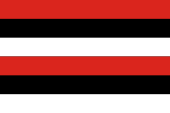 |
ca. 19. Jhd./cent. – 2011, Flagge von Shilluk – flag of Shilluk, Seitenverhältnis – ratio = 2:3, Quelle/Source, nach/by: World Statesmen |
 |
|
| Bedeutung/Ursprung
der Flagge: |
Meaning/Origin of the
Flag: |
| Die heutige Flagge des Shilluk-Königreichs zeigt sehr viele, gleich breite, waagerechte bunte Streifen. Nur der oberste, blaue Streifen ist etwas breiter und gibt so Raum für eine goldene Scheibe und einen goldenen Stern. Es fällt auf, dass die Flagge die historischen Farben Rot, Schwarz und Weiß zeigt, ergänzt um die Farben des Südsudan (Grün, Weiß, Rot, Schwarz und Blau), auf dessen Territorium sich das Königreich befindet. Möglicherweise soll so die Loyalität zum Staat Südsudan zum Ausdruck gebracht werden. Das scheint wichtig zu sein, nicht zuletzt deshalb, weil Truppen des Südsudan und Dinka-Milizen im Jahre 2010 und 2011 die Hauptstadt des Königreiches angegriffen haben. | The
today's flag of the Shilluk Kingdom, shows very many, of equal width,
horizontal colored stripes. Only the blue top stripe is slightly wider and
gives in this way more space for a golden disc and a golden star. It is
striking that the flag shows the historic colors of red, black and white,
supplemented by the colors of Southern Sudan (green, white, red, black and
blue), on whose territory the Kingdom is located. Possibly should this express loyalty to South Sudan. This seems to be important, not least because troops of Southern Sudan and Dinka militias attacked the capital of the kingdom in 2010 and 2011. |
| Quelle/Source: Volker Preuß | |
|
|
| interaktive Landkarte – interactive Map: |
|
Quelle/Source, Freeware, University of Texas Libraries, |
|
| Zahlen und Fakten – Numbers and Facts: | |
|
|
|
|
|
|
|
|
|
|
|
|
|
|
|
|
|
|
|
|
| Quelle/Source:
Wikipedia (D),
Wikipedia (EN) |
|
|
|
| Geschichte: |
| ca. 1500
· Einwanderung der christlichen, nilotischen Shilluk unter König Nyikang,
aus dem Westen des heutigen Südsudan kommend, in die heutigen
Siedlungsgebiete 16.–18. Jhd. · islamisch-arabische Attacken, ab dem 18. Jhd. auch Sklavenjagd ca. 1860–1865 · Angriffe des Osmanischen Reiches, das Königreich Shilluk verliert Einfluss und Souveränität 1881–1898 · antiägyptisch-klerikaler Mahdiaufstand unter der Führung des Mohammed Achmed, genannt Mahdi, Bildung des Mahdireiches, das christliche Volk der Shilluk gehört zu den ersten Opfern der islamischen-fanatischen Anhängerschaft des Mahdi, das Volk der Shilluk wird stark dezimiert 2010/2011 · Während des zweiten Sudanesischen Krieges, in dessen Folge der Südsudan vom Sudan unabhängig wurde, wurde das Königreich der Shilluk mehrfach von Truppen des Südsudan (SPLA) und Dinka-Milizen angegriffen |
|
|
|
| History: |
| 1500 ·
immigration of the christian, nilotic Shilluk under King Nyikang, coming
from the west of the today's southern Sudan, into their today's residential
areas 16th to 18th century · Islamic-Arab attacks, from the 18th century even slave hunting ca. 1860–1865 · Attacks by the Ottoman Empire, the Kingdom of Shilluk loses influence and sovereignty 1881–1898 · anti-Egyptian and clerical revolt under the leadership of the Mahdi, Mohammed Ahmed called Mahdi, establish of the the Mahdi empire, the Christian people of the Shilluk is among others the first victim of the islamic and fanatic followers of the Mahdi, the nation of the Shilluk becomes potently decimated 2010/2011 · During the Second Sudanese war – as a result of it the Southern Sudan became independent from Sudan – the Shilluk Kingdom was attacked by troops of South Sudan (SPLA) and Dinka militias |
| Quelle/Source: The only Project, World Statesmen, Die Völker der Erde, Wikipedia (EN) |
|

Surftipp: