Orléanais |
|
 |
|
 |
 |
|
|
|
|
| Übersicht – Contents: | |
Diese Seite ist Teil des Projektes
Orléanais |
|
|
|
|
|
|
|
|
|
| Übersicht – Contents: | |
Flagge – Flag: |
|
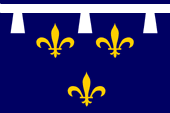 |
Flagge des Orléanais – flag of Orléanais – Drapeau de Orléanais Quelle/Source, nach/by: Wikipedia (D)
|
 |
|
| andere Flaggen – other Flags: | |
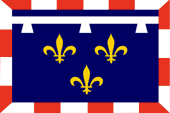 |
1960–2016, inoffizielle Flagge der Region Centre – unofficial flag of the Centre Region – drapeau officieux de la région Centre Quelle/Source: nach/by: Wikipedia (D)
|
|
|
| Bedeutung/Ursprung
der Flagge: |
Meaning/Origin of the
Flag: |
| Die Flagge des Orléanais ist eine Wappenflagge, ihr Design gibt das Bild des Wappens der Herzöge aus dem Hause Valois-Orléans wieder. | The flag of Orléanais is a scutcheon flag. Its design displays the image of the coat of arms of the Dukes out of the house of Valois-Orléans. |
| Die seit 1960 bestehende Region "Centre-Val-de-Loire" – zu der das Orléanais gehörte – verwendet eine inoffizielle Flagge, die Merkmale der histor. Flaggen von Orléanais, Berry und Touraine kombiniert. | The since 1960 existing Region of "Centre-Val-de-Loire" – to which the Orléanais belongs – uses an unofficial flag, which combines features of the historical flags of Orléanais, Berry and of the Touraine. |
| Quelle/Source: Volker Preuß, Wikipedia (D) | |
|
|
| Wappen – Coat of arms: | |
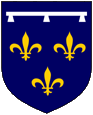 |
Wappen von Orléanais – coat of arms of Orléanais – blason de Orléanais Quelle/Source, nach/by: Wikipedia (D) |
|
|
| Bedeutung/Ursprung des Wappens: |
Meaning/Origin of the
Coat of Arms: |
| Als König Philipp VI. von Frankreich (aus dem Haus der Kapetinger) das Herzogtum Orléans schuf und an seinen jüngeren Sohn Philipp von Valois übergab, wurde für ihn das Lilienwappen der Kapetinger mit einem weißen Turnierkragen ergänzt, der Philipp – den Regeln der französischen Heraldik folgend – als jüngeren Sohn kennzeichnete. | When King Philipp VI. of France (from the house of the Capetians) created the Duchy of Orléans and handed it over to his younger son Philipp of Valois, became the lily-scutcheon of the Capetians supplemented with a white tournament collar, which featured Philipp – following the rules of the French heraldry – as a younger son. |
| Das Wappen der Kapetinger zeigte drei goldene Lilien auf Blau, jedoch war das Wappen ursprünglich mit Lilien bestreut. Ab 1365 (andere Quellen nennen 1376), wurde die Anzahl der Lilien jedoch auf drei reduziert. Das Lilien-Symbol ist sehr alt, schon der germanische Stamm der Franken hat es verwendet. | The coat
of arms of the Capetians showed three golden lilies on blue, but originally
was the coat of arms sprinkled with lilies. From 1365 (by others sources 1376), the number of lilies was reduced to three. The lily-symbol is very old, already the Germanic tribe of the Franks has used it. |
| Das Haus der Kapetinger stellte die Könige von Frankreich zwischen 987 und 1328. Es geht zurück auf Hugo Capet, Sohn von Hugo dem Großen, der nach dem Tod von Ludwig V. aus dem Hause der Karolinger im Jahre 987 zum König von Frankreich gewählt wurde. Die Kapetinger brachten drei Nebenlinien hervor, die Könige von Frankreich wurden: Valois 1328–1589, Bourbon 1589–1792 und 1814–1830, und Orléans 1830–1848. | The House of the Capetians has provided the kings of France between 987 and 1328. It goes back to Hugo Capet, son of Hugo the Great, who was electet to the King of France, in 987, after the death of King Ludwig V. from the House of the Carolingians. The Capetians brought out three branch lines which became the Kings of France: Valois 1328–1589, Bourbon 1589–1792 and 1814–1830, and Orléans 1830–1848. |
| Quelle/Source: Volker Preuß, Wikipedia (D) | |
|
|
|
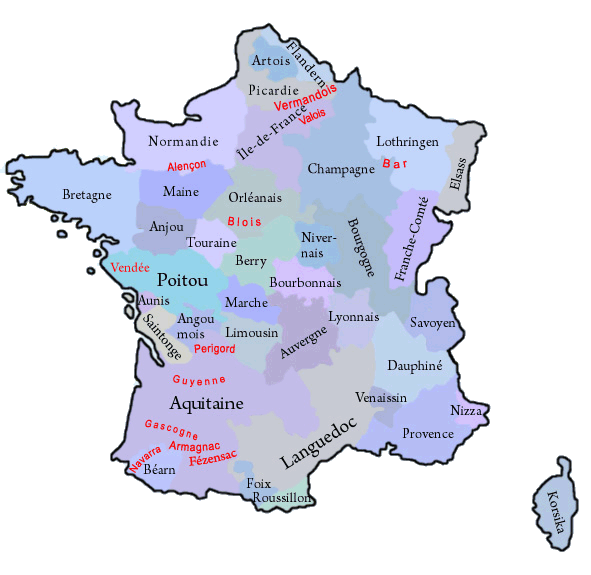
Die Regionen: Die historischen, französischen Regionen – The historical, french Regions |
|
|
in Schwarz: Provinz und Gouvernement im Jahre 1776, in Rot: ehemalige
Grafschaft, Provinz oder Gouvernement – in black: governorate and province in 1776, in red: former county, province oder governorate |
| Landkarte/Map: Volker Preuß |
|
| Erläuterungen zu den Regionen | Explanation about the Regions |
|
|
| Die bis zur Französischen Revolution bestehenden Provinzen (bzw. Gouvernements) waren historisch gewachsene Gebilde, die sich oft aus ehemaligen Lehensgebieten der französischen Krone, historischen Grafschaften und Herzogtümern heraus entwickelt hatten, oft über hunderte von Jahren bestanden und Regionalität (kulturelle Besonderheiten und regionale Sprachen) bewahrt hatten. Der Französischen Revolution waren solche Erscheinungen natürlich nicht erwünscht, und im Rahmen ihrer blutigen und gewalttätigen Gleichmacherei wurden jegliche regionale Bezüge ausgemerzt. Kurz nach der Revolution wurden die Provinzen aufgelöst und Frankreich in viele kleine Départements aufgeteilt, die annähernd gleich groß sein und den gleichen Status haben sollten, gesteuert über Präfekte der Zentralverwaltung in Paris. Benannt wurden die Départements nach Flüssen oder Gebirgen, um auf keinen Fall den Namen einer der alten Provinz zu verwenden. Es gelang jedoch nicht, die Verbindungen der Einwohner Frankreichs zu ihrer jeweiligen historisch gewachsenen Region abzuschneiden, so dass im Jahre 1960 wieder Regionen geschaffen wurden. Von wirklicher Eigenverantwortung kann dabei kaum die Rede sein. Die Regionen sollen lediglich die wirtschaftliche, soziale, gesundheitliche, kulturelle und wissenschaftliche Entwicklung der Region fördern, Wohnraum und Wohnverhältnisse im Auge behalten und bei bestimmten Themen unterstützen, z. B. bei: Städtebaupolitik, Stadtsanierung, Regionalplanung, Bewahrung der regionalen Identität und Förderung der Regionalsprachen. Bei der Bildung der Regionen wurden Départements, die in einer bestimmten historischen Provinz lagen, zu einer historisch oft gleichnamigen Region administrativ zusammengefasst. Die dabei entstandenen Gebilde deckten sich nur annähernd mit den Grenzen historischer Provinzen. Im streng zentralistischen Frankreich wird jedoch jedwede verantwortliche Regionalität vermieden. Die Regionen haben noch nicht mal eigene Siegel, mit denen eigene rechtsverbindliche Beschlüsse gekennzeichnet werden könnten. So etwas ist gar nicht vorgesehen. Von daher ist alles, was Wappen oder Flaggen angeht absolut ohne Belang. Die Logos der Regionen werden allgemein verwendet, dabei auch schon mal farblich umgekehrt und auch beliebig auf Flaggen oder Bannern platziert. Regeln gibt es keine, es sind keine offiziellen Symbole. Die Logos und Flaggen der Regionen sehen darum oft aus wie Firmenlogos, lieblos, unhistorisch, technokratisch und modernistisch. Darum gibt es den meisten dieser Regionen es eine Art von inoffiziellen Wappenflaggen, die an historische heraldische Vorbilder erinnern sollen. Diese haben aber lediglich schmückenden Charakter und sind kein Symbol hoheitlicher Aufgaben. Die 1960 angelegten Regionen wurden 2014 sogar in Frage gestellt und eine Gebietsreform beschlossen – zentral von Paris aus – welche die Anzahl der Regionen durch Fusionen auf fast die Hälfte verringerte. Die Regionen und ihre Organe wurden dazu noch nicht mal gefragt. |
The provinces (or
governorates) that existed until the French Revolution were historically
grown entities that had often developed from former fiefdoms of the French
crown, historical counties and duchies, often existed for hundreds of years
and had preserved regional characteristics (cultural peculiarities and
regional languages). Such phenomena were naturally undesirable to the French Revolution, and in the context of its bloody and violent egalitarianism, all regional references were eradicated. Shortly after the Revolution, the provinces were dissolved and France was divided into many small départements, which were to be approximately the same size and have the same status, controlled by prefects of the central administration in Paris. The departments were named after rivers or mountains so as not to use the names of any of the old provinces. However, it was not possible to sever the ties between the inhabitants of France and their respective historically grown regions, so that in 1960 regions were created again. There can hardly be said to be any real autonomy. The regions are only supposed to promote the economic, social, health, cultural and scientific development of the region, keep an eye on housing and living conditions, and provide support in some areas, e.g. urban development policy, urban regeneration, regional planning, preservation of regional identity and promotion of regional languages. When the regions were formed, departments located in a particular historical province were administratively grouped together into a region that often had the same historical name. The resulting entities only roughly corresponded to the boundaries of historical provinces. In strictly centralised France, however, any form of responsible regionalism is avoided. The regions do not even have their own seals with which to mark their own legally binding decisions, because there are no plans to introduce such a thing. Therefore, anything to do with coats of arms or flags is completely irrelevant. The logos of the regions are used generally, sometimes with the colours reversed and placed arbitrarily on flags or banners. There are no rules, as they are not official symbols. The logos and flags of the regions therefore often look like company logos: Unloving, unhistorical, technocratic and modernistic. That is why most of these regions have a kind of unofficial heraldic flag, which is intended to recall historical heraldic models. However, these are merely decorative in nature and are not a symbol of sovereign functions. The regions created in 1960 were even called into question in 2014, and a territorial reform was decided – centrally from Paris – which reduced the number of regions by almost half through mergers. The regions and their institutions were not even consulted on this matter. |
|
Wikipedia-Link zu den Regionen Frankreichs:
hier klicken FOTW-Link zu den Regionen Frankreichs: hier klicken |
Wikipedia
Link to the regions of France:
click here FOTW Link to the regions of France: click here |
| Quelle/Source: Flags of the World, Wikipedia (D), Volker Preuß | |
|
|
| Geschichte: |
|
1152
· Schaffung des Herzogtums Orléans durch König Philipp VI. von
Frankreich
durch Herauslösung des Orléanais aus der Krondomäne und übergabe an seinen
jüngeren Sohn Philipp von Valois 1375 · Philipp stirbt ohne männliche Nachkommen 1392 · Neu-Schaffung des Herzogtums Orléans durch König Karl VI. von Frankreich durch erneute Herauslösung des Orléanais aus der Krondomäne und übergabe an seinen jüngeren Bruder Ludwig von Valois, Gründung des Hauses Valois-Orléans, Ludwigs ehelicher Sohn Johann begründete die Linie der Grafen von Angoulême (mit Franz I. Könige von Frankreich), Ludwigs unehelicher Sohn Johann begründete die Linie der Herzöge von Longueville (Orléans-Longueville) 1394 · Ludwig von Orléans vererbt Herzogtum und Titel an seinen Sohn Karl 1462 · Karl von Orléans vererbt Herzogtum und Titel an seinen Sohn Ludwig 1498 · Ludwig von Orléans wird als Ludwig XII. König von Frankreich, das Herzogtum fällt zurück an die Krone, der Titel erlischt 1626 · Neu-Schaffung des Herzogtums Orléans durch König Ludwig XIII. von Frankreich durch erneute Herauslösung des Orléanais aus der Krondomäne und übergabe an seinen jüngeren Bruder Jean-Baptiste Gaston 1660 · Jean-Baptiste Gaston stirbt ohne männliche Nachkommen 1661 · Neu-Schaffung des Herzogtums Orléans durch König Ludwig XIV. von Frankreich durch erneute Herauslösung des Orléanais aus der Krondomäne und übergabe an seinen jüngeren Bruder Philipp, Gründung des Hauses Orléans-Bourbon 1701 · Karl von Orléans veerbt Herzogtum und Titel an seinen Sohn Philipp II. von Orléans (1715-1723 Regent von Frankreich), aus dieser Linie folgen noch die Herzöge Ludwig (1723–1725), Louis-Philippe (1725–1787), Louis-Philippe-Joseph (1787–1773), Ludwig Philipp (1773–1850, König von Frankreich 1830–1848) 1776 · die schon im 14. Jahrhundert geschaffenen Gouvernements der Zivilverwaltung des Königreiches Frankreich werden auf eine Anzahl von 39 Stück festgeschrieben und entsprechen so der Anzahl der Provinzen, in den Vorjahren konnten auch mehrere Provinzen in einem Gouvernement zusammengefasst sein 1789 · Französische Revolution, die Gouvernements und Provinzen werden abgeschafft, das Orléanais wird in Départements zerlegt (Loiret, Loir-et-Cher, und zum Teil auch Eure-et-Loir und Yonne) 1960 · Wiedereinführung von Regionen in Frankreich, das Orléanais spielt dabei keine Rolle, Angliederung an die neugeschaffene Region Centre-Val-de-Loire (Hauptstadt: Orléans), auch nicht innerhalb historischer Grenzen sondern nur durch Einbindung der Departements Cher, Eure-et-Loir, Indre, Indre-et-Loire, Loir-et-Cher und Loiret |
|
|
|
| History: |
|
1152
· creation of the Duchy of Orléans by King Philip VI. of
France
by separating of the Orléanais from the royal domain and handing over to his
younger son Philip of Valois 1375 · Philip dies without male descendants 1392 · re-creation of the Duchy of Orléans by King Charles VI. of France by separating of the Orléanais from the royal domain and handing over to his younger brother Louis of Valois, founder of the House of Valois-Orléans, Louis legitime son John founds the line of the Counts of Angoulême (with Francis I. as King of France), Louis illegitimate son John founds the line of the Dukes of Longueville (Orléans-Longueville) 1394 · Louis of Orléans inherits duchy and title to his son Charles 1462 · Charles of Orléans inherits duchy and title to his son Ludwig 1498 · Louis of Orléans becomes as Louis XII. King of France, the duchy comes back to the crown, the title expires 1626 · re-creation of the Duchy of Orléans by King Louis XIII. of France, by separating of the Orléanais from the royal domain and handing over to his younger brother, Jean-Baptiste Gaston 1660 · Jean -Baptiste Gaston dies without male descendants 1661 · re-creation of the Duchy of Orléans by King Louis XIV. of France, by separating of the Orléanais from the royal domain and handing over to his younger brother Philip, founder of the House of Bourbon-Orléans 1701 · Charles of Orléans inherits duchy and title to his son Philip II. of Orléans (1715-1723 Regent of France), from this line follow the Dukes Ludwig (1723-1725), Louis- Philippe (1725-1787), Louis-Philippe-Joseph (1787-1773), Louis-Philippe (1773-1850, King of France 1830-1848) 1776 · the already in the 14th century created governorates of the civil administration of the kingdom of France become committed to a number of 39, and correspond in this way to the number of provinces, in previous years could any provinces be summarized in one governorate 1789 · French Revolution, the governorates (provinces) become abolished, the Orléanais is divided into departments (Loiret, Loir-et-Cher, and partly also Eure-et-Loir and Yonne) 1960 · reintroduction of regions in France, the Orléanais doesn't play a role, affiliation with the newly created Centre-Val-de-Loire region (capital: Orléans), even not within the historic boundaries, just by integrating of the departments of Cher, Eure-et-Loir, Indre, Indre-et-Loire, Loir-et-Cher und Loiret |
| Quelle/Source: 1.) Wikipedia (D), 2.) Wikipedia (D), Meyers Konversationslexikon |
|
| Ursprung des
Landesnamens: |
Origin of the Country's
Name: |
| Der Name "Orléanais" geht auf Orléans, die Hauptstadt des Herzogtums zurück. | The name "Orléanais" has its roots in Orléans, the capital of the duchy. |
| Quelle/Source: Volker Preuß | |
|
|